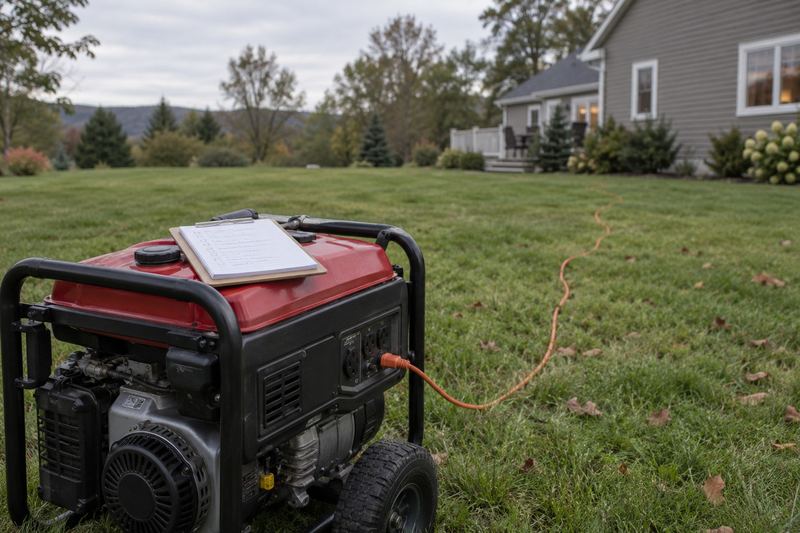
Run a portable generator outdoors only, at least 20 feet from your home with the exhaust pointed away, as the U.S. Consumer Product Safety Commission advises. Never use it in a garage, basement, porch or carport. Install battery-powered carbon monoxide alarms, refuel only when the engine is off and cool, and use outdoor-rated cords sized for the load.
Key facts
- CPSC: operate portable generators outside only, at least 20 feet from the house, with the exhaust directed away from the home and other buildings.
- CPSC estimates about 100 people in the U.S. die each year from carbon monoxide (CO) poisoning linked to portable generators.
- CDC lists headache, dizziness, weakness, upset stomach, vomiting, chest pain and confusion as common CO poisoning symptoms.
- Open windows and doors do not make indoor or garage use safe (OSHA, CDC).
- OSHA: shut the generator off and let it cool before refueling, and keep it dry.
How far should a generator be from the house?
The Consumer Product Safety Commission's current guidance is to run a portable generator outside only, at least 20 feet away from the house, and to point the exhaust away from your home and any other building people can enter. The CDC says more than 20 feet from windows, doors and vents. CPSC also says to close windows near the generator and not to run it on a porch or in a carport, because those spots are too close to the house.
You may see a much smaller clearance in an owner's manual. Honda's EU2200i manual, for example, asks for at least 3 feet of open space around and above the generator. That figure is about cooling and fire risk, not exhaust. Follow both: keep the clearance the manual asks for, and keep the generator at least 20 feet from the house.
Never run a generator inside a home, garage, basement, crawlspace, shed or any other enclosed or partly enclosed space, even with the doors open. OSHA notes that opening doors and windows may not stop CO from building up.
Why is generator carbon monoxide so dangerous?
Gasoline and propane engines produce carbon monoxide, a gas you can't see, smell or taste. A portable generator makes a lot of it in a short time. CPSC's estimate of about 100 U.S. deaths a year from portable generator CO is a reminder that this risk shows up in almost every major storm.
Symptoms of carbon monoxide poisoning
According to the CDC, common symptoms are:
- Headache
- Dizziness
- Weakness
- Upset stomach or vomiting
- Chest pain
- Confusion
The CDC describes these as "flu-like." Breathing a lot of CO can make people pass out or die, and people who are asleep or intoxicated can die before they notice anything. Infants, older adults and people with heart disease, anemia or breathing problems are more likely to become sick. If anyone has symptoms or a CO alarm sounds, get everyone into fresh air and call 911.
Where should carbon monoxide alarms go?
CPSC recommends CO alarms on every level of the home and outside separate sleeping areas. During an outage, plug-in alarms without battery backup don't work, so use battery-operated alarms or ones with battery backup. Interconnected alarms are best because they all sound together. Test them monthly and never ignore an alarm.
What is a CO shutoff feature?
Many newer portable generators have a built-in CO sensor that shuts the engine off when carbon monoxide around the generator reaches a set level. CPSC advises looking for a generator with a CO shutoff safety feature. Generator makers market these under various names; Champion, for example, describes its version as monitoring CO buildup and shutting the engine off automatically.
A shutoff is a backup, not permission to run the generator closer to the house. Champion's own product page says the feature does not replace an indoor CO alarm or safe operation. Keep the 20-foot distance and keep alarms in the home.
Can I run a generator in the rain?
Generators and water are a shock hazard. OSHA says to keep the generator dry, not to use it in rain or wet conditions, and to use a canopy-like cover if needed. Never touch it with wet hands or while standing in water. CPSC says to follow the manufacturer's instructions for bad weather, which may include using a non-combustible generator tent rated for the purpose, or waiting until rain or snow passes.
Don't solve wet weather by moving the generator into a garage or under a porch roof. That trades a shock risk for a CO risk. A listed generator cover or tent made for running generators keeps the unit dry while leaving airflow open.
- Set the generator on a dry, level surface.
- Use ground-fault (GFCI) protection where cords and equipment are in damp areas, as OSHA recommends.
- Ground the generator as its manual describes.
- Don't use equipment that has been underwater until a qualified person has dried and checked it.
What extension cords are safe with a generator?
OSHA's advice is to plug appliances directly into the generator using the maker's cords or grounded, three-prong extension cords, and to make sure each cord is rated for the watts or amps of what it powers. An underrated cord can overheat. If a cord isn't rated for the load, replace it with a heavier-gauge cord. Wire gauge numbers run backward: a lower number means thicker wire that can carry more current.
- Use cords marked for outdoor use.
- Check the cord's amp or watt rating against the load. Our watts to amps converter does the math; at 120 V, 1,500 W is 12.5 A.
- Longer runs need heavier cords, because thin wire over a long distance loses voltage and heats up. The 20-foot distance means you will need some length, so buy for it.
- Throw out cords that are cut, frayed or damaged.
- Don't run cords under rugs or through pinched doors and windows where they can be damaged.
Never plug the generator into a wall outlet to power the house. That is backfeeding, and it can electrocute utility workers. To power home circuits, have a licensed electrician install a transfer switch or interlock.
How do I refuel a generator safely?
Turn the generator off and let it cool before adding fuel. OSHA explains that fuel spilled on hot engine parts can ignite. Refuel outdoors, wipe up spills, and don't smoke nearby.
Plan refueling around the loads you really need. A smaller load stretches each tank; see what to run during a power outage and use the generator size calculator to avoid running more than you have to.
How should I store generator fuel?
OSHA recommends keeping fuel only in approved, properly labeled, vented containers, away from heat and ignition sources such as the generator itself, water heaters, matches and lighters. Fuel vapors can travel to a flame some distance away. Don't store fuel inside the home.
Gasoline also goes stale. Honda's generator fuel guidance recommends adding stabilizer to the gas can each time you fill it and notes that even treated fuel can deteriorate in long storage. Propane keeps much longer; see dual fuel generators for the trade-offs, and generator maintenance for storing the generator itself.
What about overloading?
OSHA warns that overloading a generator can overheat it and start a fire. Add up the running watts of what you plan to run, then add the largest starting surge on top. Our running vs starting watts guide explains why a refrigerator or sump pump needs extra headroom for a moment at start-up.
Safety checklist
| Topic | Do | Don't |
|---|---|---|
| Location | Outdoors, 20+ feet from the house, exhaust pointed away (CPSC) | Garage, basement, porch, carport, shed |
| CO alarms | Battery or battery-backup alarms on every level and outside sleeping areas | Rely on smell or on the generator's shutoff alone |
| Weather | Keep it dry with a cover or tent made for running generators | Move it indoors or touch it while wet |
| Cords | Outdoor-rated, grounded, rated for the load | Damaged cords or plugging into a wall outlet |
| Fuel | Engine off and cool before refueling; approved containers stored outside the home | Refuel while running or store gas indoors |
Questions people ask
How far away from the house should a generator be?
CPSC says at least 20 feet from the house, with the exhaust directed away from the home and any building people can enter. The CDC says more than 20 feet from windows, doors and vents.
Is it safe to run a generator in an open garage?
No. CPSC, CDC and OSHA all say never to run a generator in a garage, even with the door open, because carbon monoxide can still build up and seep into the house.
Does a CO shutoff generator make indoor use safe?
No. The shutoff is an added layer of protection. Makers state it doesn't replace CO alarms or safe outdoor operation, and the 20-foot rule still applies.
Can I run a generator in the rain?
Only if it is kept dry. OSHA says not to use one in wet conditions without protection; CPSC points to the manufacturer's instructions, which may call for a non-combustible generator tent or waiting until the rain passes.
What are the first signs of carbon monoxide poisoning?
The CDC lists headache, dizziness, weakness, upset stomach, vomiting, chest pain and confusion. If you suspect CO, get everyone outside to fresh air and call 911.
Sources
- CPSC: Winter storm safety tips to prevent carbon monoxide poisoning and fires
- CPSC: Carbon monoxide safety
- CDC: Carbon monoxide poisoning basics
- OSHA: Using portable generators safely (fact sheet)
- Electrical Safety Foundation: Portable generator safety
- Honda: EU2200i generator owner's manual
- Honda: Generator fuel recommendations
- Champion Power Equipment: 4500W dual fuel open frame inverter (CO Shield description)