An average US home using 863 kWh a month needs about a 5.7–8.8 kW solar system, or roughly 14 to 21 panels of 430 watts, depending on how sunny your location is. To size your own, divide your yearly kWh by peak sun hours × 365 × 0.86, then divide by your panel's watts.
Key facts
- EIA: the average US home used 863 kWh of electricity a month in 2024, about 10,356 kWh a year.
- About 97% of home solar panels quoted on EnergySage in late 2025 were 400–460 W; about 430 W was most common.
- A typical residential panel measures about 66 × 39 inches, or roughly 17.9 sq ft.
- NREL's PVWatts calculator assumes 14% system losses by default (soiling, shading, wiring, availability and more).
- NREL groups US locations by average solar resource, from under 3.75 to over 5.75 kWh per square meter per day.
How to calculate how many solar panels you need
Three numbers do the work: how much electricity you use, how much sun your roof gets, and how big each panel is.
- Find your annual use in kWh. Add up 12 months of bills, or multiply your average monthly kWh by 12. Our guide to how many kWh a house uses shows where to find it on the bill.
- Work out system size in kW:
System kW = annual kWh ÷ (peak sun hours × 365 × (1 − 0.14)) - Divide by panel size: panels = system kW × 1,000 ÷ panel watts. Round up.
The 0.14 is PVWatts' default system loss. NREL builds it from ten categories: soiling 2%, shading 3%, mismatch 2%, wiring 2%, connections 0.5%, light-induced degradation 1.5%, nameplate rating 1%, availability 3%, with snow and age set to zero. The losses multiply rather than add, which is why they come to 14% and not 15%. PVWatts separately applies a 96% inverter efficiency. If you want to include that, divide the system size by 0.96, which adds about 4%.
The solar panel calculator does this math for your own numbers.
What are peak sun hours?
Solar panels are rated at a reference sunlight intensity of 1,000 watts per square meter. One peak sun hour is one hour at that intensity, or 1 kWh per square meter. A place that receives 4.5 kWh per square meter on an average day therefore gets 4.5 peak sun hours, even if the sun is up for 12 hours.
NREL's Annual Technology Baseline sorts US residential solar sites into ten resource classes by average daily sunshine on a horizontal surface:
| NREL class | Average sunshine (kWh/m²/day) | First-year capacity factor |
|---|---|---|
| Class 1 (sunniest) | Over 5.75 | 19.6% |
| Class 3 | 5.25–5.5 | 18.0% |
| Class 5 | 4.75–5.0 | 16.1% |
| Class 7 | 4.25–4.5 | 15.2% |
| Class 9 | 3.75–4.0 | 13.9% |
| Class 10 (least sunny) | Under 3.75 | 12.7% |
Most US homes fall somewhere between about 3.75 and 5.75 peak sun hours. Panels tilted toward the sun collect somewhat more than a flat surface, and some places fall outside that range. For your address, PVWatts uses local weather data instead of a single average.
How many solar panels to power a house? Worked examples
Here is the average US home (863 kWh a month, 10,356 kWh a year) with 430 W panels and 14% losses:
| Peak sun hours | System size | 430 W panels | Panel area (17.9 sq ft each) |
|---|---|---|---|
| 3.75 (cloudier) | 8.8 kW | 21 | About 376 sq ft |
| 4.5 (middle) | 7.3 kW | 18 | About 322 sq ft |
| 5.75 (sunniest) | 5.7 kW | 14 | About 251 sq ft |
The middle row step by step: 4.5 × 365 × 0.86 = 1,413 kWh per kW per year. 10,356 ÷ 1,413 = 7.33 kW. 7,330 W ÷ 430 W = 17.05 panels, which rounds up to 18.
Household use varies a lot by state. In EIA's 2024 figures, Louisiana homes averaged 1,202 kWh a month and California homes 503 kWh. Here is how that changes the answer at 4.5 peak sun hours:
| Monthly use | Annual use | System size | 430 W panels |
|---|---|---|---|
| 500 kWh | 6,000 kWh | 4.2 kW | 10 |
| 863 kWh (US average) | 10,356 kWh | 7.3 kW | 18 |
| 1,200 kWh | 14,400 kWh | 10.2 kW | 24 |
Check your state's average use and price on the electricity rates page.
A reality check from NREL
NREL's capacity factors work out to roughly 1,100 to 1,700 kWh per kW of panels per year across those classes. The simple formula gives about 1,180 to 1,800, about 5% higher. Inverter losses and the heat that lowers panel output account for much of the gap, so adding the 96% inverter factor brings the two close. The formula is good for a first estimate, not a quote.
How much electricity does one solar panel produce?
Multiply panel watts by peak sun hours by 365, then by 0.86 for losses. For a 430 W panel:
- At 3.75 peak sun hours: about 506 kWh a year
- At 4.5 peak sun hours: about 607 kWh a year
- At 5.75 peak sun hours: about 776 kWh a year
That works out to roughly 1.4 to 2.1 kWh per panel per day, before inverter losses. EnergySage, using its own production ratio, estimates a 430 W panel in California at about 645 kWh a year. To convert between watts, kWh and other units, use the energy converter.
What size are solar panels, and will they fit on my roof?
EnergySage lists a typical residential panel at about 66 inches by 39 inches (5.5 by 3.25 feet), 1.5–2 inches deep and around 40–50 pounds. That is about 17.9 sq ft per panel. Most home panels now fall between 400 and 460 W, so higher-wattage panels mean fewer of them for the same system size.
The panel areas in the tables above are the panels alone. Real layouts also need space for gaps between rows, roof edges, vents, chimneys and any setbacks your local fire code requires. Roof direction, tilt and shade all change how much each panel produces, so a less ideal roof may need more panels for the same kWh.
Why an installer's PVWatts estimate is the real answer
The formula assumes one average sun-hour figure and a standard 14% loss. A proper estimate accounts for things it can't:
- Your exact location and weather. PVWatts, NREL's free online calculator, uses typical-year (TMY) weather data from the National Solar Radiation Database for your location.
- Roof tilt and direction. PVWatts lets you enter your roof's actual tilt and azimuth instead of assuming an ideal angle.
- Shade. Trees and neighboring buildings can cut output by more than the 3% default.
- Inverter sizing. PVWatts' current version defaults to a DC-to-AC ratio of 1.2. NREL's reference rooftop system is 7.9 kW DC with a ratio of 1.21.
- Your utility's rules. How your utility credits exported power can make it worth covering all of your use, or only part of it. Ask before you settle on a size.
- Future loads. An EV, heat pump or electric water heater can add a lot to your annual kWh. Our appliance pages, such as the EV charger and heat pump, give typical use.
Run your address through PVWatts yourself, then compare it with each installer's production estimate. If one quote promises much more output from the same number of panels, ask why. Prices change quickly and vary by region and incentives, so compare current written quotes rather than national averages. The electricity cost calculator shows what the kWh you would offset are worth at your rate.
Rooftop solar and power outages
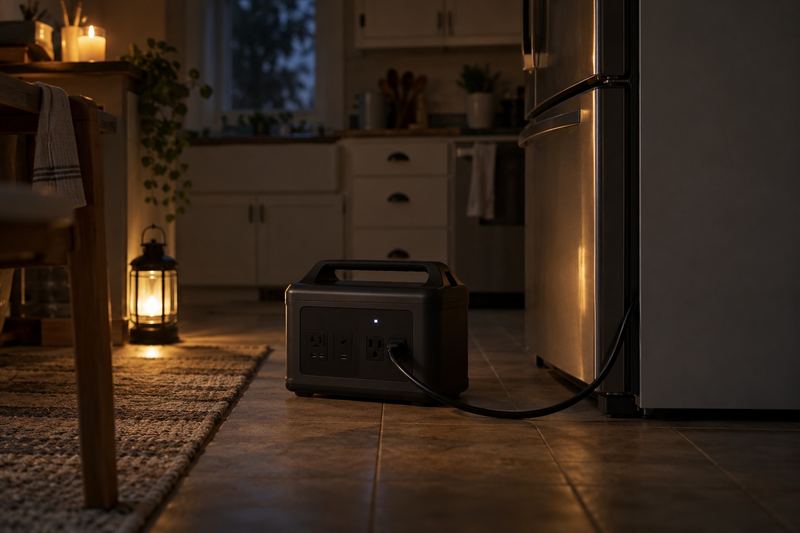
Panels alone usually won't keep your lights on. The Department of Energy explains that small solar inverters disconnect from the grid and shut down when a disruption is long or large, and that solar-plus-battery systems can run through an outage only if they are designed to. Backup equipment must be installed by a licensed electrician. For a smaller setup, a portable power station with folding panels can cover essentials; see how long a power station will last and power station vs generator.
Questions people ask
How many solar panels do I need for a 2,000 sq ft house?
Floor area doesn't decide it; electricity use does. A home using the US average of 863 kWh a month needs roughly 14 to 21 panels of 430 W, depending on peak sun hours.
How many solar panels does it take to power a house?
Divide annual kWh by (peak sun hours × 365 × 0.86) to get system kW, then divide by panel kW. At 4.5 peak sun hours, an average home needs about 7.3 kW, or 18 panels of 430 W.
How many solar watts do I need?
About 1 kW of panels for every 1,180 to 1,800 kWh you use a year, by the simple formula. Cloudier areas are at the low end of that output, so they need more watts.
What wattage are home solar panels?
EnergySage reports that about 97% of home panels quoted in late 2025 were 400–460 W, with about 430 W the most common.
How much roof space do solar panels need?
Each typical panel covers about 17.9 sq ft, so 18 panels take about 322 sq ft before spacing and setbacks. Usable roof area is usually the real limit.
How accurate is a solar panel calculator?
It gives a first estimate. An installer's design, or your own PVWatts run using your address, roof angle and shading, is the number to rely on.
Sources
- NREL: PVWatts Version 5 Manual
- NREL: PVWatts V8 API documentation
- NREL: PVWatts Calculator
- NREL: Annual Technology Baseline 2024, Residential PV
- U.S. Energy Information Administration: Electric Sales, Revenue, and Average Price (2024 data)
- U.S. Department of Energy: Solar integration, inverters and grid services basics
- EnergySage: How much energy does a solar panel produce?
- EnergySage: Solar panel size and weight